Author: martina

African Migration, Knowledge, and Transfers in German Literature

The seminar Migration, Wissens- und Kulturtransfer: Afrikanische Migrantenliteratur in Deutschland will take place on Thursday, October 2, in Room S.11 (Department of Foreign Languages and Literatures, basement floor – Lungadige Porta Vittoria 41, Verona). The seminar will be held by Prof. Ibrahima Diagne from the Cheikh Anta Diop University in Dakar (Senegal).

Prof. Diagne, a visiting professor funded by the UNITAFRICA project of the Italian Ministry of University and Research, is currently in Verona to delve into intercultural communication topics. The focus of his lecture will be migration writing and autobiographical narratives within the Afro-German context.

Ibrahima Diagne arrives in Verona with UNITAFRICA

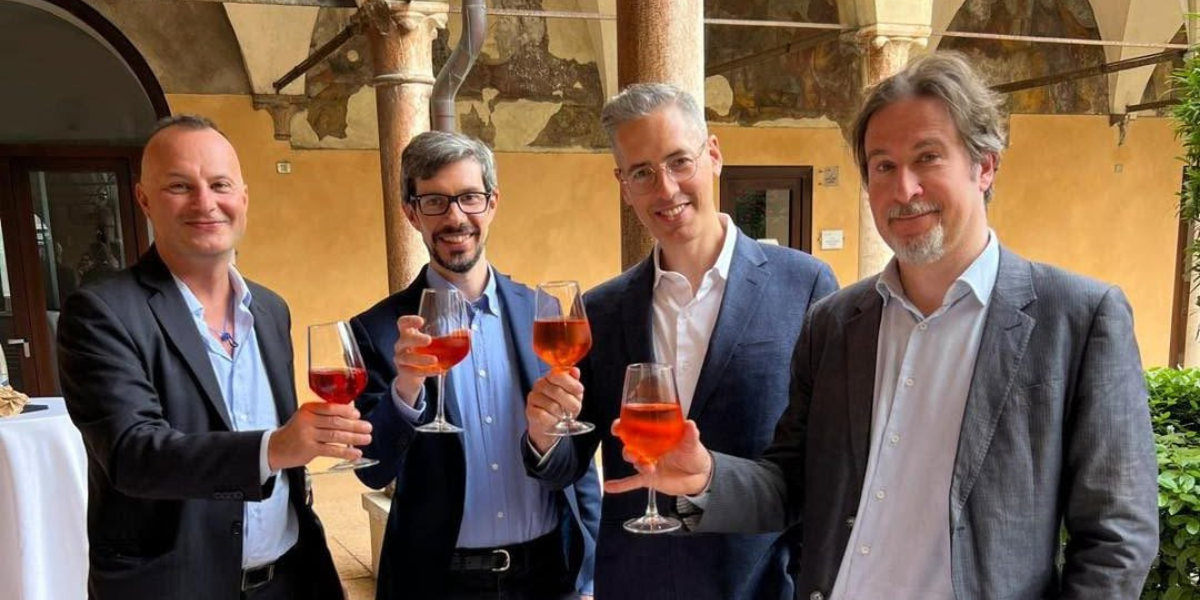
Massimo Salgaro e Ibrahimine Diagne

A warm welcome to Ibrahima Diagne, Visiting Professor from the Cheikh Anta Diop University in Dakar (Senegal). Prof. Diagne, welcomed to our department by Massimo Salgaro, is funded by the UNITAFRICA project of the Italian Ministry of University and Research.

The goal of UNITAFRICA is to strengthen academic cooperation between Italy and Africa, promoting the quality and effectiveness of higher education systems within a framework of mutual exchange. Prof. Diagne’s teaching and research program focuses primarily on intercultural communication, migration writing, and autobiographical narratives within the Afro-German context, as well as the poetics of postcolonialism, post-migration, decoloniality, and transculturality. These activities align perfectly with the objectives of the “Inclusive Humanities” Excellence Project of the Department of Foreign Languages and Literatures at the University of Verona, which aims to understand and promote the overcoming of gender, economic, social, and cultural disparities that affect how the world is perceived both inside and outside the university.

Olboblo. Arte potenziale is now a Podcast

Introducing Olboblo, the new podcast from our department and the official audio guide for the exhibition of the same name, “Olboblo. Arte potenziale” (Potential Art). This project is the result of an agreement between the Academy of Fine Arts of Verona and the Department of Foreign Languages and Literatures, developed within the “Inclusive Humanities” Excellence Project.

The guide was created not only to accompany visitors through the exhibition’s paintings and installations, but more importantly, to convey art, colors, and nuances to those who cannot fully experience them due to a disability, with a strong focus on inclusion and accessibility. Thanks to the collaboration with curator Daniela Rosi from the Academy of Fine Arts of Verona and student-artists Isabella Besutti, Giulia Martinuzzi, Eleonora Mutto, Claudia Sallustio, and Sara Zottarelli, we will introduce the five artworks that make up the 2024-2025 edition, which will be open to visitors until October 2025.

The 19th episode of ‘Inclusioni’ is now online

Have you ever heard of vicarious trauma? If you are not sure what it means, tune in to the nineteenth episode of Inclusioni, now online. Vicarious trauma is a phenomenon that stems from the empathetic engagement between someone in a helping profession—such as an interpreter—and those who have directly experienced a trauma. In contexts of severe suffering, such as illnesses and wars, this trauma also affects the very profession that, above all, gives a voice to those living through these experiences: interpreting.

We discuss this with Sara Polidoro, an interpreter and scholar at the Department of Interpreting and Translation of the University of Bologna. Sara Polidoro’s research project focuses on the impact of traumatic material on interpreters who assisted the Ukrainian population arriving in Italy due to the war.

The interview is conducted by Daniele Artoni, professor of Slavic Studies at our Department.

The 18th episode of ‘Inclusioni’ is now online

The eighteenth episode of Inclusioni—the podcast channel of the Department of Foreign Languages and Literatures at the University of Verona—is now online on all major platforms. The episode is titled “Ambassadors of Freedom: the historical experience of Ukrainian women in international politics and diplomacy.”

In this episode, we explore an often overlooked yet fundamental chapter of Ukrainian history: the crucial role played by Ukrainian women in international politics and diplomacy. Our guest, Alla Shvets, Deputy Director of the Ivan Franko Institute and a prominent figure in the Association for Research in Women’s History, discusses how Ukrainian women acted as true ambassadors of freedom within the international political and diplomatic arena, shaping and representing Ukraine on the global stage.

The interview, conducted in English, is hosted by Olivia Guaraldo, Full Professor of Political Philosophy at the Department of Human Sciences and the Rector’s Delegate for Public Engagement at the University of Verona.

Communication and Inclusion in European University Language Centres: Results from the PRIN Workshop

European University Language Centres and inclusion: these were the core themes of the workshop “Communication and Inclusion in EULCs: building on our research”, co-funded by the MUR (Ministry of University and Research) as part of the PRIN 2022 project. The workshop, which took place on Friday, June 27, at the Santa Marta campus, provided an important opportunity for discussion on communication and inclusion policies within European language centres, which play an extremely significant role in the language training of university students.

The event opened with presentations from the University of Verona, featuring Sharon Hartle, Paola Vettorel, and Elena Borsetto on “The CEFR CV: Focus on Interaction and Communication Strategies”. This was followed by the research unit from the University for Foreigners of Siena, with Valentina Tomassini and Emilia Petrocelli presenting “Esplorare l’inclusione sociale su Instagram: un’analisi con Eye tracking delle pagine di CLA italiani, spagnoli e inglesi” (“Exploring social inclusion on Instagram: an eye-tracking analysis of Italian, Spanish, and English university language centre pages”), and Daniele Corsi on “Ocularizzazione e eye tracking: un’indagine sul montaggio interno nei piani sequenza di Welles e Hitchcock e implicazioni pedagogiche” (“Ocularization and eye-tracking: an investigation into internal editing in long takes by Welles and Hitchcock and pedagogical implications”).

In the afternoon, the research unit from the University of Rome ‘Foro Italico’—represented by Alessandra Fazio, Michela Menghini, and Valeria Tamburini—delivered their presentation titled “University Sport Centres representations: places of multilingual interaction and inclusion?”. Finally, the unit from the University of Calabria, with Anna Maria de Bartolo, Carmen Argondizzo, Vanessa Marcella, Michael Cronin, and Sergio Pizziconi, concluded with their talk on “Including and Feeling Included: Representations and Perceptions of University Language Centres”.